Adult & Baby Diaper Machine,Sanitary Napkins Production Line Blog
Build an infant diaper line maintenance system with asset hierarchy, task ownership, justified triggers, work control, spares, records, and improvement.
An infant diaper production line maintenance system is the controlled framework that identifies assets, assigns task ownership, selects intervals and condition triggers, plans work, governs spares and changes, records findings, verifies recovery, and improves from failures and product trends. It is broader than a preventive-maintenance calendar. The system must connect operators, maintenance specialists, quality, production, safety, engineering, and stores from material unwind through conversion, inspection, rejection, counting, and downstream interfaces. A maintenance manager should be able to answer which asset is at risk, why work is due, who is authorized, what evidence defines completion, and whether the intervention restored safe production of conforming diapers.
Define System Purpose and Boundary
The system exists to manage asset risk through the equipment lifecycle. Its goals are safe function, controlled product quality, predictable access to production, prepared recovery, preserved configuration, and usable evidence for decisions. It should not reward task volume or document completion without regard to condition and effectiveness.
Set a physical boundary that includes main converting stations and dependencies: material handling, unwinds, web guidance, absorbent-core equipment, vacuum, extraction, adhesive systems, applicators, elastic feeds, cutters, folders, conveyors, controls, sensors, inspection, rejection, counting, packaging interfaces, utilities, guards, and safety functions. Name the owner of each interface even when another department maintains it.
Set an information boundary as well. Controlled drawings, part lists, software and recipes, alarms, work orders, condition readings, production events, quality checks, nonconformities, material lots, spare transactions, training, and change records should be connectable through consistent asset and time references. The system need not be one software package, but users must be able to reconstruct an event without conflicting names and missing revisions.
System test: select a recent product defect or stop. If the team cannot trace the asset, machine state, material, recipe, condition history, work performed, parts, verification, and product disposition, the maintenance system has an information gap.
Build the Infant Diaper Production Line Asset Hierarchy
Use levels that support planning: site or factory, line, functional zone, asset, maintainable item, and controlled component. The exact number of levels can fit the local system, but names and identifiers should remain stable. Each maintainable item connects to location, function, drawings, task plans, safety method, spare references, failure codes, condition points, and product characteristics.
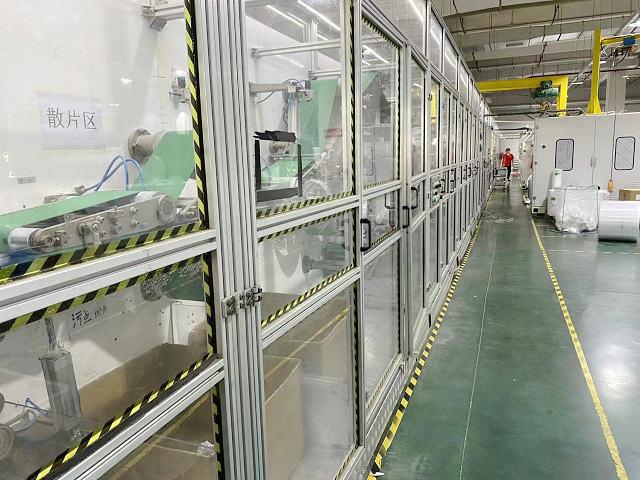
Asset hierarchy connects the complete line with zones, maintainable items, tasks, spares, and records.
Criticality should record consequence of functional loss: safety, environment, undetected product risk, complete or partial production loss, secondary damage, detectability, redundancy, recovery path, and technical complexity. Do not classify only by replacement price or failure frequency. A low-cost inspection sensor can be critical when its failure allows defects to pass; an expensive component may have stable monitoring and a controlled backup.
Review criticality when equipment, products, materials, packaging, safety functions, or operating campaigns change. Preserve the reason and approval. Use the result to decide task depth, monitoring, spare strategy, work priority, recovery plans, and engineering review. Criticality does not automatically make every job urgent; current condition and controls determine timing.
Hierarchy record
Required content
Decision it supports
Audit sample
Functional zone
Purpose, interfaces, utilities, product effects
Ownership and line-level diagnosis
Trace one defect upstream through zones
Maintainable item
Location, reference, task, safety state, condition point
Every task should state asset, purpose, failure effect, authorized role, machine state, safety method, tools and parts, steps, acceptable condition, finding code, escalation, completion evidence, and post-work test. Avoid instructions such as "inspect and clean as needed" unless the acceptable condition and approved cleaning method are defined.
Use role levels based on competence. Operators can perform authorized external observations, cleaning, material-path care, and basic functional checks. Mechanical, electrical, controls, lubrication, and condition-monitoring specialists handle qualified work. Engineering and safety roles approve changes and high-risk methods. Quality defines product checks and disposition. Production controls access and operating plans but should not override technical release.
Triggers may be per shift, campaign, elapsed time, usage, cycle, material exposure, condition limit, product trend, alarm event, changeover, shutdown opportunity, or after another task. Choose the trigger from supplier information, failure behavior, duty, environment, and site evidence. Review it when repeated failures occur before the task or when inspections repeatedly find no relevant condition.
Task ownership should match safe access, technical competence, and product-release responsibility.
Train to competence. The person should demonstrate identification, isolation or approved safe state, document use, condition judgment, correct action, record completion, and recovery. Record authorization by task family and shift. Attendance alone does not prove that the person can recognize a limit or safely restore the asset.
Run a Controlled Work Management Cycle
Identify: create work from due tasks, operator findings, quality trends, alarms, failures, inspections, or changes.
Schedule: coordinate production closeout, materials, isolation, specialists, and downstream dependencies.
Execute: record as-found condition, work, deviations, measurements, parts, and controlled changes.
Release: restore safety, test function, run representative product, and obtain required authorization.
Close and learn: verify record quality, update follow-up, and review effectiveness later.
Work readiness is a formal state. A job is ready only when prerequisites are available and confirmed. Distinguish planned but not ready, ready but unscheduled, scheduled, in progress, technically complete, awaiting product verification, and closed. This prevents the system from hiding work that has been physically touched but not safely released.
Emergency work follows the same controls at compressed pace. Protect people, contain product, preserve alarms and settings, identify the failed function, secure qualified resources, verify the replacement and method, and define recovery. Create follow-up work for analysis, permanent correction, document updates, spare replenishment, and similar-asset review.
For automatic infant diaper manufacturing equipment, request enough installation and maintenance documentation to populate the hierarchy and tasks. HAINA can support configuration-specific handover and training, while the factory owns local authorization, scheduling, and record governance.
Integrate Spares, Records, and Change Control
The spare register connects part identity to the installed asset and approved design. Include reference, revision or rating, compatibility, installed quantity, stock, storage, shelf or condition constraints where provided, special installation needs, repair option, criticality rationale, and replenishment owner. Inspect on receipt and before use. Quarantine unidentified, damaged, obsolete, or unapproved parts.
Use transaction history for decisions. A part consumed repeatedly may need root-cause work. A critical part never used may still be justified if failure consequence and sourcing exposure are high. A high-value part may not need local stock if a controlled repair or redundancy exists. Document the rationale rather than copying another factory's quantity.
Work records should retain as-found condition, confirmed and suspected causes separately, actions, parts, measurements, settings, people, time, safety restoration, product checks, and follow-up. Standard failure codes help trending, but do not replace the original symptom. If coding changes later, preserve the source observation.
Spares and records are useful when they remain tied to the current installed configuration and evidence.
Change control covers replacement alternatives, mechanical modifications, control hardware, software, recipes, materials, maintenance methods, intervals, safety functions, and inspection. Review effects on drawings, backups, spares, training, risk, quality, and acceptance. Update the site master after approval. Remote technical advice should enter the record with evidence and site verification.
Use a Maintenance Continuous-Improvement Loop
Review at several levels. Shift review handles immediate findings, product status, and temporary controls. Weekly planning reviews work readiness, schedule, backlog risk, parts, and access. Monthly reliability review examines repeat failures, small stops, condition trends, quality links, task effectiveness, spare consumption, and unresolved causes. Periodic governance review audits the asset register, authorization, change control, and recovery tests.
Select losses by consequence, recurrence, evidence quality, and improvement opportunity.
State the failure mechanism as a hypothesis and record conflicting evidence.
Assign containment, correction, prevention, owner, due date, and verification condition.
Check similar assets without assuming they share the same duty or cause.
Compare later equivalent product and operating conditions using stable definitions.
Update tasks, triggers, spares, drawings, training, and controls only when evidence supports the change.
Continuous improvement closes the loop from condition and failure evidence to verified system changes.
Use balanced measures: work readiness, critical overdue work, condition findings, repeat failures, schedule completion, post-maintenance defects, small-stop categories, quality trends, and open follow-up. Do not optimize one metric at the expense of reporting and evidence. Audit samples of completed work to verify that closure means safe, effective restoration rather than administrative completion.
Frequently Asked Questions
Is a maintenance schedule the same as a maintenance system?
No. A schedule lists due work. A system also controls assets, ownership, safety, condition, planning, spares, records, changes, recovery, product release, competence, and continuous improvement.
Who owns the maintenance system?
The maintenance manager usually governs it, but production, operators, safety, quality, engineering, controls, and stores own defined inputs and approvals. Executive support is needed for risk and access decisions.
How should task intervals be selected?
Use supplier guidance, failure behavior, duty, environment, usage, material exposure, condition trends, product consequence, and site history. Review intervals when findings and failures show they are ineffective.
What is the best audit of system effectiveness?
Trace representative due work, a condition finding, a recurring fault, and a change from detection through planning, execution, product release, record quality, follow-up, and verified prevention.
Conclusion
A maintenance system turns equipment knowledge into repeatable ownership and evidence. Build the infant diaper production line hierarchy, rank consequences, assign competent roles, choose justified triggers, manage ready work, control spares and changes, and require technical and product release before closure. Then audit one planned task, one recurring fault, and one approved modification end to end. Before accepting the system or equipment handover, the maintenance manager should verify that each sample can be traced through the current configuration, safe method, findings, parts, product checks, follow-up, and effectiveness review, closing any information or ownership gap discovered.