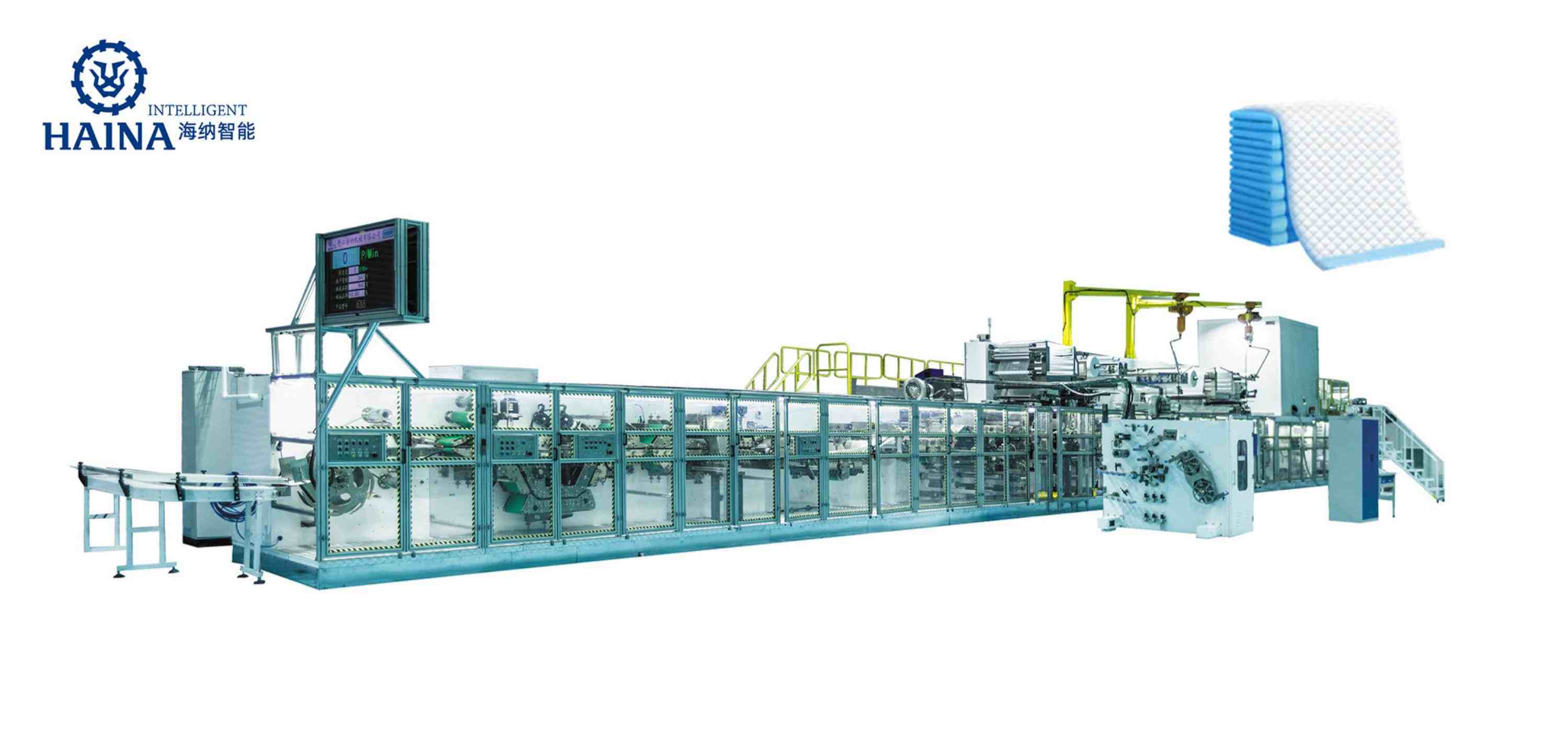
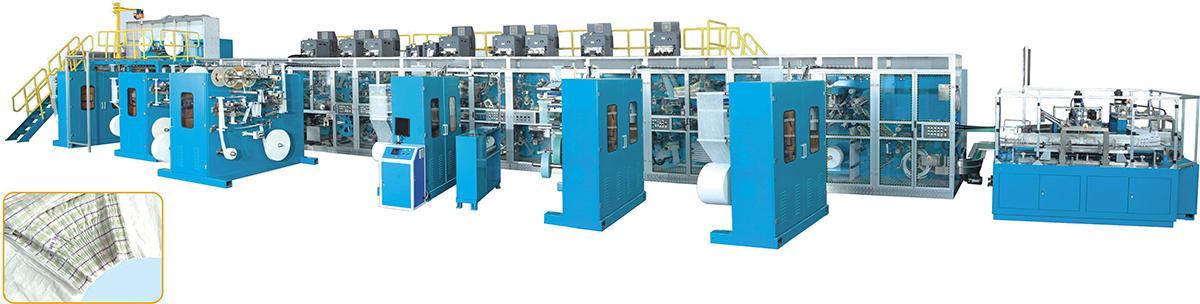
Infant diaper production line capacity should be estimated from stable working speed, operating efficiency, rejection rate, and scheduled production time, not from design speed alone. For the HAINA TK900, published model specifications list a design speed of 900 pieces per minute, a stable working speed of 800 pieces per minute, efficiency of at least 85 percent, and rejection of no more than 4 percent. Using those reference values gives an estimated 39,168 accepted pieces per hour. This is a planning calculation based on published specifications, not a promise of actual output or a substitute for contractually defined acceptance testing.
Start with the Right Capacity Language
A useful capacity discussion begins by separating speed capability from saleable production. The figures may appear similar in a quotation, but they measure different stages of machine performance. Buyers who use one figure for every calculation may overestimate monthly output, raw-material demand, packaging capacity, and expected revenue.
Design speed is a published engineering speed for the machine platform. It indicates the speed level considered in the mechanical and control design. It can help a buyer understand the technical class of a line, but it does not show how many accepted diapers will leave the factory during every scheduled hour.
Stable working speed is the more practical starting point for routine capacity planning. It represents continuous operation under defined conditions, including a specified diaper design, suitable materials, trained operators, stable utilities, and correctly adjusted equipment. Even stable speed remains a speed value rather than a final accepted-output value.
Operating efficiency accounts for the time that does not become effective production. Stops may result from roll changes, web breaks, adhesive adjustments, cleaning, alarms, inspection, material preparation, product changeovers, or downstream packaging interruptions. The exact efficiency definition matters because factories do not always classify planned and unplanned time in the same way.
Rejection rate accounts for pieces that are produced but do not satisfy agreed quality requirements. A production line can run at the expected speed while accepted output falls because of component position, cutting, adhesive, elastic, core formation, appearance, or dimensional problems. Capacity planning should therefore end with accepted pieces, not gross machine cycles.
Compare Design Speed and Stable Output
The TK900 figures used in this article are published model specifications. They should be treated as reference inputs for evaluation. Any guaranteed acceptance value must be written separately into the commercial contract and technical agreement, together with the conditions used to measure it.
Capacity item
Published TK900 value
What the value describes
Correct planning use
Design speed
900 pieces per minute
The published engineering speed level of the model
Use for technical comparison, not as continuous accepted output
Stable working speed
800 pieces per minute
The published stable operating speed under defined conditions
Use as the primary speed input for a realistic capacity estimate
Efficiency
At least 85 percent
The published efficiency reference for the model
Apply only after the efficiency formula and time boundaries are agreed
Rejection rate
No more than 4 percent
The published maximum rejection reference
Convert it to accepted yield and define which defects are counted
At 900 pieces per minute, design-speed arithmetic produces 54,000 theoretical pieces per hour before any time or quality adjustment. At 800 pieces per minute, stable-speed arithmetic produces 48,000 theoretical pieces per hour. The 6,000-piece difference is important, but neither number is yet an estimate of accepted hourly production. Efficiency and rejection must still be considered.
Specification note: Published values describe the model under stated or expected conditions. They do not independently define the test product, materials, test duration, utility quality, operator responsibilities, downtime rules, or quality sampling method. Those details determine whether a result can be verified and accepted.
Use a Repeatable Capacity Formula
A transparent formula allows engineering, purchasing, production, and finance teams to work from the same assumptions. It can be used for hourly, shift, daily, or monthly estimates as long as all inputs refer to the same production period.
Accepted output = stable speed x 60 x scheduled hours x operating efficiency x accepted yield
Accepted yield = 1 - rejection rate
The workflow is straightforward:
Select stable working speed as the normal planning speed. Keep design speed visible as a specification comparison, but do not insert it into the routine output forecast.
Multiply pieces per minute by 60 to calculate theoretical stable pieces per hour.
Multiply by scheduled hours for the period being planned. Use actual production hours rather than assuming that every calendar hour is available.
Apply the agreed operating-efficiency rate. Confirm whether maintenance, cleaning, warm-up, size changes, and planned breaks are included in the scheduled-time denominator.
Subtract the rejection rate from 100 percent to obtain accepted yield, then apply that yield to effective production.
Check whether inspection, stacking, bagging, case packing, conveying, and warehouse handling can support the resulting flow.
Losses should not be counted twice. If a factory efficiency calculation already removes rejected products from effective output, applying a separate rejection factor could understate capacity. If efficiency measures runtime only, rejection normally remains a separate quality adjustment. The buyer and supplier should agree on one written calculation method before comparing results.
Calculate TK900 Hourly and Shift Output
The calculation begins with the published stable working speed of 800 pieces per minute. Multiplying by 60 gives theoretical stable production before efficiency and rejection:
800 pieces per minute x 60 minutes = 48,000 gross pieces per hour
Applying the published efficiency reference of at least 85 percent gives 40,800 effective pieces per hour when the calculation uses 85 percent as its planning assumption:
48,000 x 0.85 = 40,800 effective pieces per hour
A rejection rate of no more than 4 percent corresponds to an accepted yield of 96 percent when the estimate uses the maximum published rejection reference. Applying that yield gives:
40,800 x 0.96 = 39,168 estimated accepted pieces per hour
For an eight-hour scheduled shift using the same assumptions, estimated accepted output is 313,344 pieces. For 20 scheduled production hours, the estimate is 783,360 accepted pieces. These totals do not mean that every factory will achieve the same result. They demonstrate how the published specification inputs interact when used in a capacity model.
The calculation also explains why design speed should not be presented as stable saleable output. Multiplying 900 pieces per minute by 60 gives 54,000 theoretical pieces per hour, but this ignores efficiency, rejection, and operating conditions. It is a design-speed comparison, not a finished-goods forecast.
Account for Variables That Change Output
Actual output can move above or below a planning estimate as production conditions change. A meaningful assessment of an automatic baby diaper manufacturing machine should examine the complete process rather than one speed figure.
Diaper construction: Product size, absorbent-core weight, elastic layout, waist design, acquisition layers, and cutting patterns can affect adjustment time and stable operation.
Material consistency: Roll diameter, web tension, thickness variation, splice quality, pulp condition, absorbent polymer behavior, and adhesive compatibility influence continuity.
Changeover frequency: A factory producing many sizes or short orders may lose more scheduled time than a factory running one product for long campaigns.
Operator readiness: Trained teams can identify web tracking, feeding, cutting, sensor, and adhesive problems earlier and restore stable operation more efficiently.
Utilities and environment: Power quality, compressed air, dust extraction, temperature, and humidity can affect equipment and material behavior.
Maintenance condition: Blade wear, sensor contamination, belt tension, lubrication, alignment, and replacement-part planning influence both stops and product quality.
Downstream capacity: Stackers, baggers, case packing, conveyors, quality inspection, and warehouse handling must support the converting line without creating repeated stops.
For this reason, capacity records should include speed, runtime, stop duration, stop cause, gross pieces, rejected pieces, accepted pieces, product size, and material batch. The resulting data helps a factory identify whether lost output comes from machine settings, materials, operation, maintenance, quality control, or packaging.
Build a Practical Acceptance Checklist
A capacity claim becomes useful when it can be tested under written conditions. The factory acceptance test and final acceptance procedure should state exactly what is being measured, how long it will be measured, and which evidence both parties will approve.
Capacity and acceptance checklist
Identify the exact diaper size, construction, bill of materials, and approved material suppliers used for the test.
Define the test duration, warm-up period, continuous running period, sampling intervals, and rules for restarting a test.
State the target stable speed separately from the published design speed.
Write the efficiency formula, scheduled-time boundary, and treatment of planned and unplanned downtime.
Define rejection categories, startup waste, splice waste, quality samples, and the method for counting accepted pieces.
List required utility conditions, environmental conditions, operators, and responsibilities during the test.
Confirm that downstream stacking and packaging can receive the test output without artificially limiting the converting line.
Record which values are published references and which values, if any, are contractual acceptance commitments.
Quality criteria should reflect the agreed product. Typical checks may include dimensions, component position, absorbent-core formation, elastic application, cutting condition, adhesive condition, appearance, and other customer specifications. The acceptance document should not treat speed as successful when products produced at that speed fail the agreed quality standard.
Apply the Result to Factory Planning
Accepted hourly output supports several connected decisions. To estimate required monthly production hours, divide the monthly saleable-product target by the planned accepted output per hour. Then add defined time for preventive maintenance, sanitation, trials, changeovers, and production uncertainty rather than hiding every allowance inside one efficiency assumption.
Raw-material planning should start with the bill of materials per accepted diaper and then include justified allowances for startup, trim, splices, sampling, and rejection. Packaging planning should use accepted flow and short-term peak flow, because average hourly output can hide brief periods when the bagger or manual packing team receives products faster than expected.
Warehouse and logistics plans also depend on the result. The factory needs enough space for incoming rolls, absorbent materials, packaging supplies, work in progress, and finished cartons. Labor planning should consider operation, quality inspection, material movement, packaging, maintenance, and shift coverage rather than assuming that automation eliminates every supporting task.
After commissioning, planned capacity should be compared with recorded production by product and shift. A simple weekly review of the main stop causes, rejection categories, changeover duration, and packaging constraints can reveal where improvement work will have the greatest effect.
Capacity Questions Buyers Commonly Ask
Is 900 pieces per minute the expected continuous TK900 output?
No. The 900 pieces per minute figure is the published design speed. The published stable working speed is 800 pieces per minute. Continuous accepted output must also account for efficiency, rejection, product conditions, materials, utilities, operators, maintenance, and downstream handling.
How is the estimate of 39,168 accepted pieces per hour calculated?
The estimate uses 800 pieces per minute x 60 minutes x 85 percent efficiency x 96 percent accepted yield. The 96 percent yield is derived from a 4 percent rejection assumption. It is a transparent planning example based on published model specifications, not a guaranteed production result.
Should a buyer calculate daily capacity from 24 hours?
Only when the plant genuinely schedules 24 production hours and the efficiency definition properly accounts for maintenance, cleaning, breaks, changeovers, material preparation, and other time losses. Using actual scheduled production hours generally produces a more useful forecast.
What is the best way to verify stable production output?
Run an agreed product with approved materials for a defined test period. Record speed, runtime, every stop, gross pieces, rejected pieces, accepted pieces, and quality results. Both parties should approve the measurement rules before the test so the result can be reproduced and audited.
Why might two factories obtain different output from the same model?
They may use different diaper designs, materials, order lengths, changeover schedules, utilities, operator teams, maintenance practices, quality standards, and packaging systems. Model specifications are important reference points, but the surrounding production system determines how those specifications translate into accepted output.
Conclusion
Infant diaper line capacity should be calculated from stable working speed and then adjusted for operating efficiency, rejection, and actual scheduled production time. For the TK900, the published design speed of 900 pieces per minute describes the model's engineering speed level, while the published stable working speed of 800 pieces per minute is the more appropriate starting point for routine planning.
Using 85 percent efficiency and a 4 percent rejection assumption produces an estimated 39,168 accepted pieces per hour. This number is a planning example derived from published specifications. Buyers should establish any promised result through signed technical documents that define the product, materials, test duration, calculation rules, quality criteria, and acceptance method.